Where there is a plant factory, there is Opticlimatefarm.
Language
Where there is a plant factory, there is Opticlimatefarm.
In the commercial execution of high-density vertical farming, the invisible laws of fluid dynamics dictate the baseline dividing line between financial scale and operational bankruptcy. If your micro-airflow architecture is flawed, the most advanced lighting spectrums and elite crop nutrients become completely useless assets. The Opticlimatefarm airflow matrix does not merely 'move air'; it surgically re-constructs the microclimate of the three-dimensional cultivation envelope. Eliminating spatial dead zones is the absolute prerequisite to eliminating crop disease, ensuring your enterprise delivers standardized, peak-valuation harvests with mathematical predictability.
Aerodynamics of High-Density Vertical Spaces: Eliminating Microclimatic Dead Zones and Bud Rot Through Precision Air Velocity Architecture
Introduction
When a cultivation facility scales vertically from single-tier benches into multi-layer racking arrays (3, 4, or more tiers), the spatial fluid dynamics undergo a radical transformation. Thousands of high-transpiration plants are compressed into dense, stacked vertical canopies, creating an incredibly tight, resistant biological jungle.
Many commercial operators suffer from a critical engineering misconception: 'As long as the total BTU cooling and pints-per-day dehumidification capacities of my central HVAC plant are balanced, the room environment will be uniform.' This oversight yields devastating real-world outcomes: crops positioned directly adjacent to primary supply ducts suffer severe wind burn, while the core center of the multi-tier racks—where foliar density is highest—experiences total air stagnation. These stagnant zones quickly morph into high-humidity thermal microclimatic islands, serving as the primary vectors for devastating fungal outbreaks, including Grey Mold (Botrytis / Bud Rot) and Powdery Mildew.
1. The Three-Dimensional Microclimate Crisis: Foliar Boundary Layers and Thermal Stagnation Islands
To optimize airflow physics, one must first isolate the biological concept of the 'Leaf Boundary Layer.' As a cannabis plant transpires, its stomatally active surfaces continuously pump out water vapor. If the ambient air surrounding the leaf structure is stationary, this vapor forms a microscopic, hyper-saturated envelope of stagnant humidity directly against the leaf tissue.
Botanical Consequences: This boundary layer chokes gas exchange, blocking carbon dioxide (CO2) assimilation and stalling transpirational pull. The crop experiences physiological suffocation, causing photosynthetic conversion efficiencies to plummet.
Pathogenic Risks: Within high-density vertical racks, thousands of individual leaf boundary layers overlap. Simultaneously, radiant heat from the LED drivers overhead gets trapped between the tight vertical shelf clear-spaces. This constructs a 'high-humidity thermal island' completely insulated from distant wall-mounted sensors. The moment localized relative humidity crosses 85% in a stagnant zone, fungal spores germinate in hours, liquefying premium flower buds from the inside out.
2. The Opticlimatefarm Precision Airflow Architecture
Standard facilities attempt to resolve stagnation by packing multi-tier racks with dozens of cheap, oscillating fans. This archaic fix generates chaotic turbulence, hot-air looping, and violently disperses localized fungal pathogens throughout the entire facility. Opticlimatefarm replaces this with a highly engineered matrix combining variable-frequency central air handling, customized static pressure fabric ducting, and automated vertical laminar flow displacement.
2.1 Locking the 'Goldilocks Air Velocity Zone': 0.3 m/s – 0.5 m/s
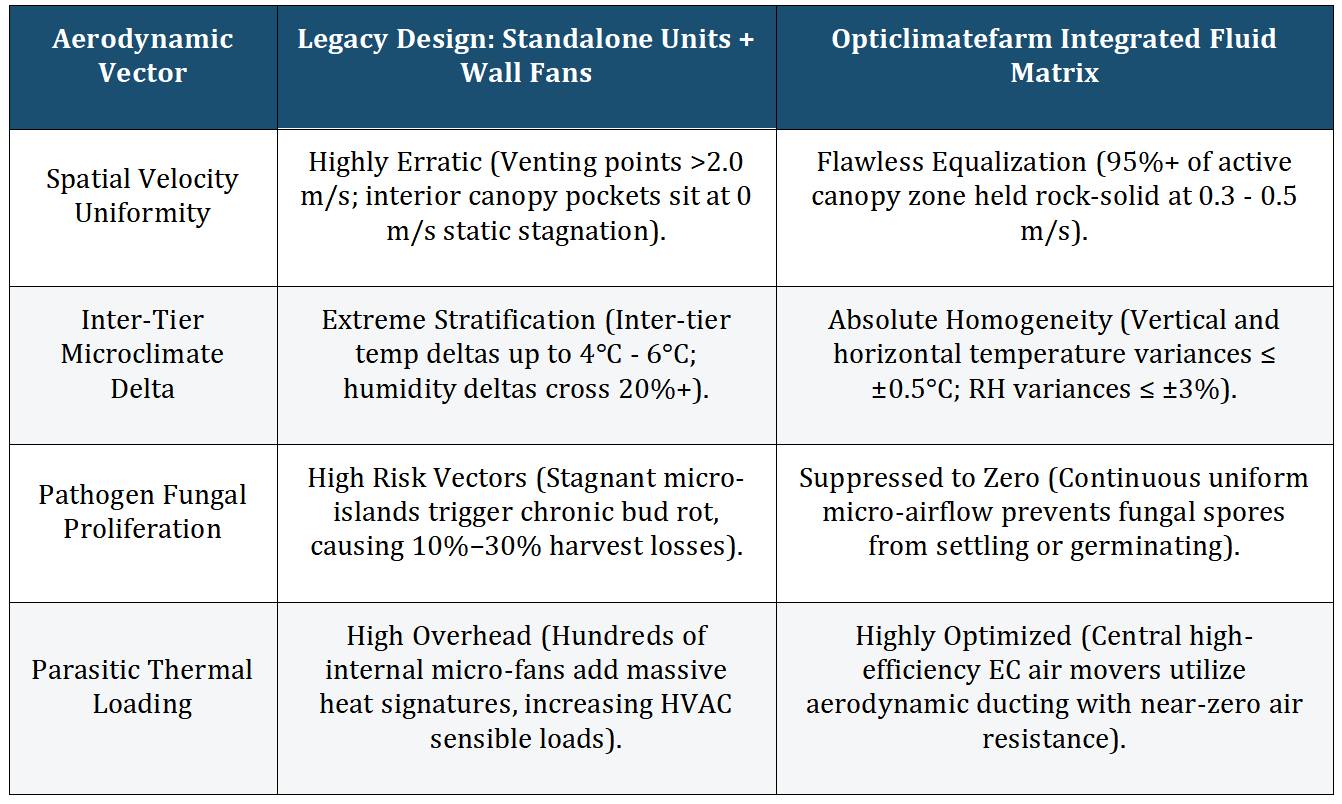
Aerodynamic fluid models prove that the absolute optimal velocity required to break the foliar boundary layer without inducing plant stress sits precisely between 0.3 and 0.5 meters per second. Velocities below 0.2 m/s fail to disrupt the boundary layer, trapping humidity and stalling nutrient uptake. Velocities exceeding 1.0 m/s trigger systemic wind burn, forcing the plant to close its stomata for survival, which induces stunting and internodal stretching.
Opticlimatefarm utilizes central EC fans regulated by real-time static duct pressure sensors. Regardless of filter particulate loading or canopy density expansion, the system maintains a gentle, uniform air velocity across every square inch of the canopy, locked precisely in the goldilocks zone.
2.2 Integrated Multi-Tier Micro-Perforated Fabric Air Distribution
Traditional HVAC engineering dumps cold conditioned air from overhead ceiling diffusers. In a multi-tier vertical farm, the top shelves act as solid umbrellas, completely blocking air penetration and leaving lower shelves suffocated and overheated.
The Opticlimatefarm Solution: We deploy specialized, food-grade micro-perforated fabric air distribution tubes engineered directly into the inner interstitial space of each racking tier. Conditioned, ultra-dry air is evenly distributed across every shelf level. Through thousands of laser-cut micro-apertures mapped via Computational Fluid Dynamics (CFD) modeling, air descends like a gentle, uniform waterfall, completely enveloping the canopy.
Negative-Pressure Displacement Return: Simultaneously, negative-pressure air returns are integrated at the base of the racks or floor levels, actively pulling the warm, humid transpired air downward away from the flowers. This continuous vertical laminar loop completely neutralizes the structural obstacles of multi-tier vertical farming.
3. Enterprise Fluid Dynamics Comparison: Legacy Arrays vs. Opticlimatefarm Integration
The Definitive Corporate Conclusion
In the commercial execution of high-density vertical farming, the invisible laws of fluid dynamics dictate the baseline dividing line between financial scale and operational bankruptcy. If your micro-airflow architecture is flawed, the most advanced lighting spectrums and elite crop nutrients become completely useless assets. The Opticlimatefarm airflow matrix does not merely 'move air'; it surgically re-constructs the microclimate of the three-dimensional cultivation envelope. Eliminating spatial dead zones is the absolute prerequisite to eliminating crop disease, ensuring your enterprise delivers standardized, peak-valuation harvests with mathematical predictability.
Get In Touch With Us
Just leave your email or phone number in the contact form so we can send you a free quote for our wide range of designs!

Copyright © 2026 OPTICLIMATE FARM LIMITED - opticlimatefarm.com All Rights Reserved.
 +86 15018079703