Where there is a plant factory, there is Opticlimatefarm.
Language
For indoor vertical farming of saffron (Saffron / Crocus sativus), the light recipe design differs fundamentally from conventional leafy greens or fruit crops. As a high-value bulbous plant, saffron possesses a unique physiological cycle consisting of corm development, dormancy, flowering, and vegetative growth.
In a closed indoor vertical environment, Opticlimatefarm’s core commercial objectives are: to stimulate flowering and maximize the accumulation of key secondary metabolites (such as crocin) during the flowering phase, and to fully rejuvenate the corms during the post-flowering vegetative phase, overcoming the industry pain point of "corm degradation in the second year" typical of traditional indoor cultivation.
Indoor Vertical Saffron Cultivation: Full-Cycle Intelligent Spectrum Modulation Strategy
Written by the Opticlimatefarm High-Value Crop Spectral R&D Team
For indoor vertical farming of saffron (Saffron / Crocus sativus), the light recipe design differs fundamentally from conventional leafy greens or fruit crops. As a high-value bulbous plant, saffron possesses a unique physiological cycle consisting of corm development, dormancy, flowering, and vegetative growth.
In a closed indoor vertical environment, Opticlimatefarm’s core commercial objectives are: to stimulate flowering and maximize the accumulation of key secondary metabolites (such as crocin) during the flowering phase, and to fully rejuvenate the corms during the post-flowering vegetative phase, overcoming the industry pain point of "corm degradation in the second year" typical of traditional indoor cultivation.
1. Full-Cycle Spectrum Modulation Strategy
1.1 Flowering Stage: The "Visual Switch" for High Quality and Yield
Recommended Spectrum: Red:Blue = 3:1 to 4:1, incorporating FR (Far-Red, 730nm) and trace amounts of UVA (385–400nm).
Technical Logic:
Far-Red (FR) Elongation Effect: Integrating 5%–10% FR triggers the plant's shade-avoidance response, effectively stimulating the elongation of saffron filaments (stigmas), which greatly facilitates manual harvesting.
* UVA for Active Ingredients: Trace amounts of UVA strongly stimulate secondary metabolic responses, significantly boosting the concentrations of crocin (coloring power), picrocrocin (flavor), and safranal (aroma) in the stigmas—the definitive metrics for premium market pricing.
* Blue Light for Structural Rigidity: Maintaining around 20% blue light ensures a compact structure for petals and anthers, preventing premature floral wilting.
1.2 Post-Flowering Vegetative & Corm Bulbing Stage: Rejuvenating Subterranean Energy
Recommended Spectrum: Increase red light proportion, Red:Blue = 5:1 to 6:1, minimize or shut off UVA, and maintain a moderate proportion of green/white light.
Technical Logic:
* Red Light-Driven Dry Matter Transport: Post-flowering, the swelling of new subterranean corms requires peak photosynthetic efficiency. A high ratio of red light (660nm) maximizes the translocation of starch and carbohydrates to the underground corms, accelerating enlargement and securing next year's commercial bloom.
The product has many excellent features such as optimum performance, longer service life, and so on.
* Green Light (520–550nm) Deep Penetration: Due to the high density of vertical racking, the canopy becomes heavily crowded with long leaves in the mid-to-late stages. Introducing 10%–15% full-spectrum green light allows penetration through dense leaf layers to reach the lower canopy and base, boosting the overall canopy photosynthetic rate.
2. PPFD & Photoperiod Design
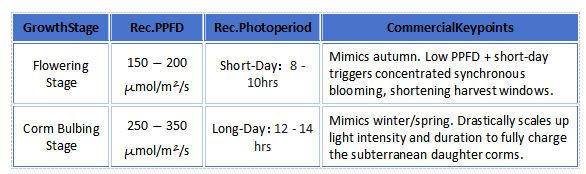
Saffron is highly sensitive to light intensity and photoperiod. Phase-based control is essential to optimize operational expenses (OPEX) while securing yield.
3. Professional Pitfall Avoidance Guide for Vertical Saffron Lighting
3.1. Avoid Excessive PPFD During Flowering
Excessively high blue light or intense PPFD will severely inhibit the longitudinal elongation of flower buds, causing blooms to get stuck inside the corm's protective bracts, leading to significant crop losses.
3.2. Implement Dynamic Spectral Switching Systems
Saffron's spectral requirements across different stages are fundamentally conflicting. Fixed-spectrum fixtures fail to balance stigma quality with corm rejuvenation. Therefore, Opticlimatefarm strongly recommends integrating a programmable multi-channel dynamic spectrum control system.
3.3. Synergize Thermal and Climate Control
Saffron flowering requires a cool climate (15°C–18°C). Although LEDs emit low heat, thermal accumulation still occurs on multi-tier vertical racks. The lighting configuration must be deeply integrated with Opticlimatefarm's climate control systems to ensure canopy surface temperature remains within targets.
Expert Conclusion
For Opticlimatefarm, the core selling proposition of the vertical saffron solution lies in the multi-tier commercial premium driven by dynamic spectral control. By elevating the concentration of active compounds in first-grade stigmas through advanced lighting, and solving the industry-wide curse of "second-year corm degradation" via vegetative recipes, this full-cycle spectral asset management represents the true pathway to scalable profitability in indoor vertical saffron cultivation.
Get In Touch With Us
Just leave your email or phone number in the contact form so we can send you a free quote for our wide range of designs!

Copyright © 2026 OPTICLIMATE FARM LIMITED - opticlimatefarm.com All Rights Reserved.
 +86 15018079703

