Where there is a plant factory, there is Opticlimatefarm.
Language
Enterprise vertical farming cannot be successfully managed as a fractured puzzle of 'lights, HVAC, and watering pipes.' In a commercial facility, the crop tissue functions as the literal thermodynamic conductor connecting these three physical pillars. The Opticlimatefarm platform is a fully synthesized digital life-support OS. By ensuring your climate infrastructure possesses real-time predictive knowledge of your irrigation loop, environmental adjustments perpetually front-run biological reactions, crushing utility overhead while harvesting the highest-yielding, most lucrative boutique crops in the marketplace.
Integrated Fertigation and Climate Synchronization: Demolishing Post-Irrigation Humidity Spikes via Automated Feed-Forward Algorithms
Introduction
Within the sealed infrastructure of a commercial vertical farm, water operates under a strict, unyielding law of thermodynamics: conservation of mass. Of the nutrient-rich water absorbed by the root zone of a cannabis plant, only a microscopic fraction (approximately 1%–2%) is retained to build physical cellular biomass. The remaining 98%+ is fully released into the cultivation room atmosphere via foliar transpiration. This dictates a hard operational math: if your fertigation platform injects 500 liters of water into a flower zone today, your HVAC infrastructure must surgically extract precisely 490 liters of water vapor from the air.
The engineering breakthrough of Opticlimatefarm is absolute: We establish a direct communication bridge between the automated fertigation loop (drip/ebb-and-flow) and the central HVAC matrix, deploying 'Feed-Forward Control' to stabilize the environment before transpiration even manifests.
1. The Commercial Cost of Transpiration: The Financial Outflow of Passive Legacy Reaction
The moment high-EC nutrient solutions hit the root substrate (such as rockwool or coco coir), the osmotic potential of the root zone shifts aggressively. Under intense photoperiod radiation, the plants experience a massive transpirational spike lasting 1 to 2 hours. Stomata open to maximum aperture, and internal water reserves pump into the air like an atmospheric fountain.
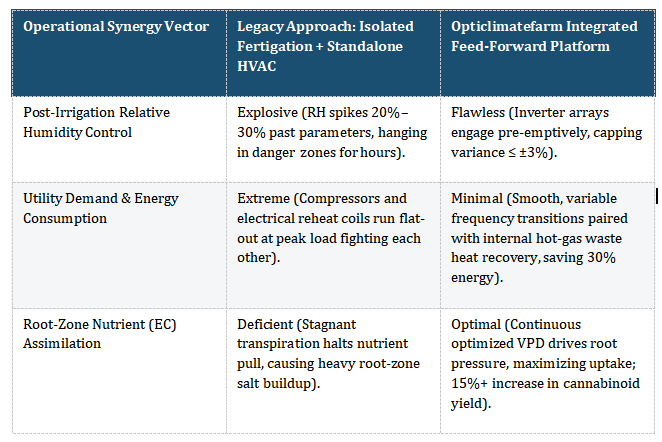
The Financial Penalty of Legacy Automation: Standard environmental sensors are mounted passively on walls. By the time they register an ambient room humidity jump from 55% to 75%, the microclimatic core within the dense plant canopy has already hit 100% RH dew point condensation. Standard standalone dehumidifiers and AC compressors slam into 100% peak capacity, violently battling each other's thermal footprints for 3 consecutive hours. This erratic, high-draw operation spikes peak-demand utility penalties (OPEX expansion). Furthermore, because localized VPD has collapsed into the danger zone, the plants completely halt the uptake of vital calcium and magnesium ions, permanently bottlenecking final harvest weights.
2. The Opticlimatefarm Integrated 'Light-Water-Air' Feed-Forward Engine
2.1 Millisecond Feed-Forward Activation (Pre-Emptive Strike)
The millisecond the automated fertigation loop triggers an irrigation sequence—precisely 5 minutes before the first drop of water leaves the drip emitters—the central network transmits a 'Pre-Emptive Feed-Forward Signal' to the integrated HVAC handlers. The air handler's variable-frequency EC fans and inverter compressors spin up immediately, proactively dropping the ambient room dew point temperature and elevating micro-airflow velocity ahead of the transpirational surge. The moment the canopy begins releasing its vapor pulse, the climate infrastructure is already operating at its peak thermodynamic dehumidification efficiency. The room humidity curve remains locked on a flat, horizontal axis, with variances capped at an unnoticeable ≤ ±3%.
2.2 Dynamic VPD Modulation Synced to Substrate Dry-Backs
The cyclic dry-back of the root substrate governs the metabolic pacing of high-value crops:
- P1 Phase (Saturation/Irrigation Window): Substrate volumetric water content (VWC) is maxed out. The Opticlimatefarm network drives the environment to a slightly higher target VPD (e.g., 1.2 kPa). This gentle atmospheric dryness increases the transpirational pull, forcing the roots to aggressively pull nutrients upward into developing floral sites.
- P2 Phase (Dry-Back Window): Irrigation halts; the substrate begins its structured dry-back. To prevent plant fatigue and cellular stress, the automation network seamlessly scales room parameters down to a softer target VPD (0.9 - 1.0 kPa), allowing the crop to rest and maximize carbohydrate accumulation.
3. The Enterprise Ledger: Segmented Architecture vs. Opticlimatefarm Light-Water-Air Integration
The Definitive Corporate Conclusion
Enterprise vertical farming cannot be successfully managed as a fractured puzzle of 'lights, HVAC, and watering pipes.' In a commercial facility, the crop tissue functions as the literal thermodynamic conductor connecting these three physical pillars. The Opticlimatefarm platform is a fully synthesized digital life-support OS. By ensuring your climate infrastructure possesses real-time predictive knowledge of your irrigation loop, environmental adjustments perpetually front-run biological reactions, crushing utility overhead while harvesting the highest-yielding, most lucrative boutique crops in the marketplace.
Get In Touch With Us
Just leave your email or phone number in the contact form so we can send you a free quote for our wide range of designs!

Copyright © 2026 OPTICLIMATE FARM LIMITED - opticlimatefarm.com All Rights Reserved.
 +86 15018079703

