Where there is a plant factory, there is Opticlimatefarm.
Language
The competition among modern plant factories has evolved past the primitive stage of comparing facility square footage or capital size. Adjusting parameters blindly or following trends without data is the greatest risk for vertical farming investors.
A meticulously customized, crop-specific "intelligent light recipe" provides a vastly superior return on investment (ROI) compared to simply dumping capital into more hardware. Unlocking the precise spectrum for your crop is the true underlying code to turning around profitability and securing sustained commercial success.
Deciphering Light Recipes: The Invisible Profit Lever for Commercial Plant Factories
Written by the Chief Plant Factory Light Recipe Expert Team at Opticlimatefarm
In the commercial arena of vertical farming, investors often pour millions into cutting-edge automation and advanced climate control systems (HVAC), yet frequently stumble on the most critical variable: the light recipe.
Given identical supportive policies and baseline hardware costs, why does one plant factory yield hundreds of thousands in surplus profits while its neighbor faces substantial losses? The answer does not lie in the sheer scale of the facility, but rather in whether the light provided to the crops is "ineffective illumination" or a "high-value recipe". In a closed vertical farming environment, light is not merely an energy source—it serves as the ultimate commander of crop morphology and yield.
1. The Scientific Fundamentals of Red-to-Blue Ratios
Before optimizing specific crop formulas, we must clarify how red and blue spectrums drive photosynthesis and photomorphogenesis:
Red Light (630–660 nm) — The Engine of Yield
Red light is the most efficient band for driving photosynthesis.
It is primarily responsible for accelerating cell division, promoting dry matter accumulation, and boosting overall crop yield.
It significantly increases the conversion and accumulation of carbohydrates, such as soluble sugars.
Blue Light (400–470 nm) — The Controller of Quality
Blue light acts as the command center for quality and morphology, regulating plant architecture and structure.
It effectively controls node spacing to prevent excessive elongation (stretching).
It strongly stimulates the synthesis of secondary metabolites, optimizing nutritional profiles and visual appearance.
The scientific balance of a red-to-blue ratio essentially targets the dynamic sweet spot between biomass (yield) and commercial presentation (quality). This equilibrium is the ultimate key to profitability.
2. Spectrum Modulation Strategies for Core Commercial Crops
Adjusting spectrums blindly leads to high trial-and-error costs. Below are four field-proven spectrum strategies for core vertical farming crops:
Leafy Greens (e.g., Lettuce): The Golden Ratio for Yield and Efficiency
Recommended Red-to-Blue Ratio: 4:1 to 6:1 (with 4:1 being the optimal baseline for morphological balance).
Technical Logic: This ratio maximizes the rate of biomass accumulation while effectively suppressing excessive elongation caused by over-exposure to red light. When integrated strategically with photovoltaic supplemental lighting, operational expenses (OPEX) tied to electricity can be drastically reduced.
Premium Quality Strategy: If the market demands enhanced nutritional value or crisper textures, the proportion of blue light can be boosted up to 30% to stimulate chlorophyll and dietary fiber production.
Leeks: Breaking the Yield Ceiling of Conventional White Light
Recommended Red-to-Blue Ratio: 5:1 to 7:1.
Technical Logic: Within this specific spectral window, the photosynthetic rate of leeks is maximized. Production data indicates that this formula drives a yield increase of over 38% compared to standard white LED control groups.
Pitfall Avoidance: Leeks are highly sensitive to blue light levels. An excessively low proportion of blue light results in sparse leaves and a decline in quality, whereas an overly high proportion strongly inhibits normal vegetative growth.
Tomato Seedlings & Night Supplementation: Multi-Spectral Synergy
Seedling Stage Formula: Red:Blue:White:UVA = 8:4:5:1.
Technical Logic: Introducing trace amounts of UVA (near-ultraviolet light) during the nursery stage is crucial for raising robust seedlings. It triggers a mild stress-response defense mechanism, significantly enhancing stress resistance and laying a solid foundation for subsequent high fruit yields and premium quality.
Mature Night Supplementation: Once the plants enter the fruiting stage, if nighttime supplemental lighting is applied, a simplified red-to-blue ratio of 5:1 is fully adequate to sustain growth.
Red-Leaf Vegetables (e.g., Red Leaf Lettuce): The Spectral Switch for Anthocyanin
Core Requirement: The blue light proportion must account for a strict 10%–18%.
Technical Logic: The commercial value of red-leaf crops hinges on their deep red or purple coloration, which is entirely dependent on anthocyanin synthesis. If blue light drops below 10%, the plant cannot effectively synthesize anthocyanin, resulting in pale green leaves that fail to command premium market prices.
Premium Value Tip: For high-end organic or premium markets, pushing the blue light ratio to 15%–18% during the final growth stages intensifies the deep purple coloration, directly lifting the market value by more than 30%.
3. Commercial Decision-Making: Biomass Volume vs. Premium Quality
In commercial vertical farming, spectral fine-tuning is always tied to market strategy. Consider this empirical test data comparing different spectrum layouts for lettuce:
Light Recipe (Red:Blue)
Fresh Weight per Plant
Secondary Metabolites (Anthocyanins/Vitamins)
Market Positioning & Commercial Strategy
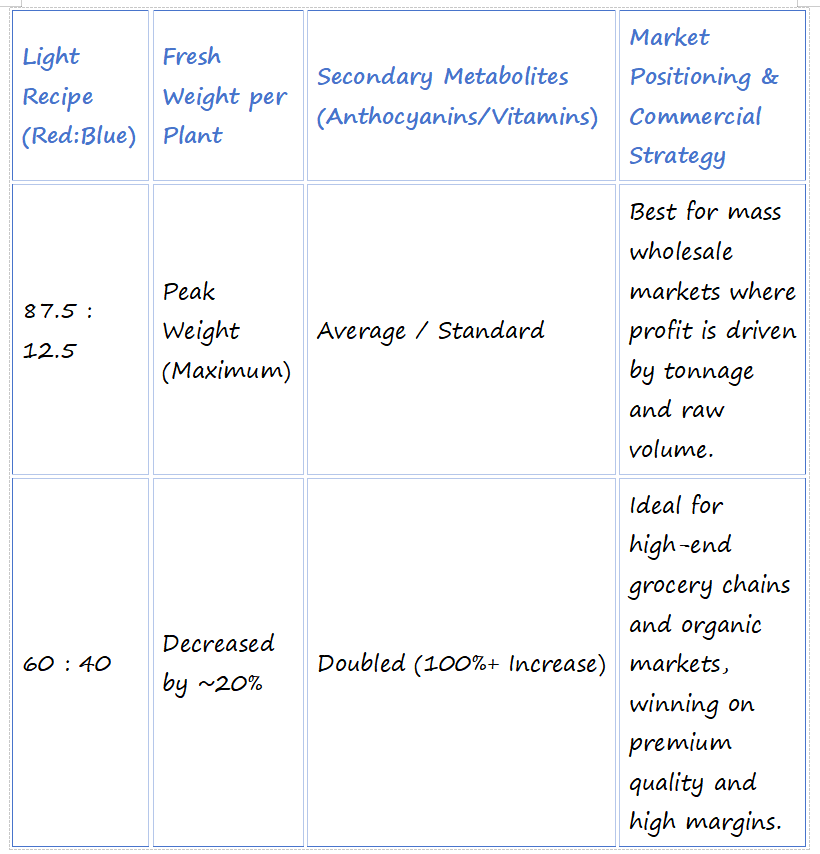
This demonstrates that light recipe adjustments are not a blind pursuit of technology, but rather a dynamic asset that must be tailored precisely to your sales channels and brand positioning.
Expert Conclusion
The competition among modern plant factories has evolved past the primitive stage of comparing facility square footage or capital size. Adjusting parameters blindly or following trends without data is the greatest risk for vertical farming investors.
A meticulously customized, crop-specific "intelligent light recipe" provides a vastly superior return on investment (ROI) compared to simply dumping capital into more hardware. Unlocking the precise spectrum for your crop is the true underlying code to turning around profitability and securing sustained commercial success.
Get In Touch With Us
Just leave your email or phone number in the contact form so we can send you a free quote for our wide range of designs!

Copyright © 2026 OPTICLIMATE FARM LIMITED - opticlimatefarm.com All Rights Reserved.
 +86 15018079703

